
Turn Your Skills into Support: Earn & Grow with Us
In today’s digital world, your skills are your greatest asset. Whether you are a writer, a designer, or a student with a dream, there are ways to sustain yourself while you build your future.
How We Help You Earn
At Donation Help Now, we don't just give donations; we empower individuals to become self-sufficient.
Skill-Based Sponsorships: Share your talents (like art, coding, or teaching) on our platform, and connect with donors who want to fund your growth.
Micro-Grants for Freelancers: If you need a laptop or a specific tool to start your online career, our community is here to help you get started.
Success Through Knowledge: We provide resources and guides on the best legitimate ways to earn money online, from freelancing to digital marketing.
Legitimate Online Earning Paths
Freelancing & Service-Based Roles
Graphic Design
Content Writing
Video Editing
Data Entry Services
Virtual Assistant
Translation Services
Transcription
Voiceover Artist
Proofreading & Editing
Resume & Cover Letter Writing
Digital Marketing & Strategy
Social Media Management
SEO (Search Engine Optimization) Specialist
Affiliate Marketing
Email Marketing Campaigns
PPC (Pay-Per-Click) Ads Specialist
Creative & Content Creation
YouTube Content Creation
Professional Blogging
Stock Photography Sales
Podcasting
Selling Digital Products (E-books/Templates)
TikTok Brand Partnerships
NFT Art Creation
E-commerce & Sales
Dropshipping Business
Print on Demand (T-shirts/Merch)
Etsy Shop (Handmade Goods)
Amazon FBA (Fulfillment by Amazon)
Local E-commerce (Daraz/Social Media Shops)
IT, Software & Development
Web Development
Mobile App Development
Software Quality Assurance (Testing)
UI/UX Design
Cybersecurity Consulting
Education, Coaching & Consulting
Online Tutoring
Creating & Selling Online Courses
Language Coaching
Career & Life Coaching
Online Fitness Training
Specialized Tasks & Emerging Trends
Online Paid Surveys
Website & App User Testing
AI Data Labeling & Training
Social Media Influencing
Domain Flipping
App Referral & Loyalty Programs
Game Streaming (Twitch/YouTube)
Stock Market Investing
Cryptocurrency Trading
Ghostwriting
Online Bookkeeping
Remote Travel Consultant
Remote Technical Support
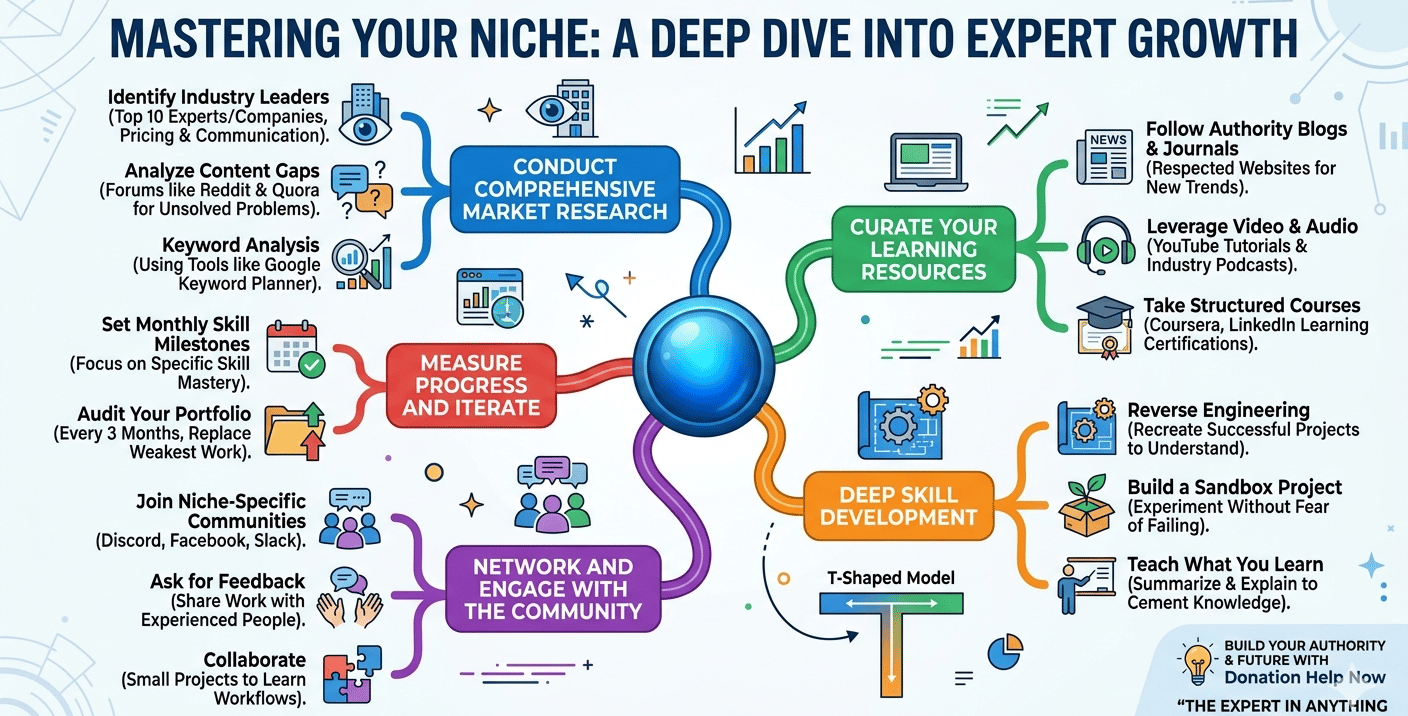
Mastering Your Niche: A Deep Dive into Expert Growth
Selecting a niche is just the foundation. To stand out in the digital market, you must transition from a beginner to a specialist. Here is how you can systematically research and dominate your chosen field.
1. Conduct Comprehensive Market Research
Before you start working, you must understand the landscape of your niche.
Identify Industry Leaders: Find the top 10 experts or companies in your niche and study their work, their pricing, and how they communicate with clients.
Analyze Content Gaps: Look at forums like Reddit or Quora to see what questions people are asking and what problems aren't being solved.
Keyword Analysis: Use tools like Google Keyword Planner to find out what specific terms people are searching for within your niche.
2. Curate Your Learning Resources
Don't just rely on one source; build a personal "knowledge library".
Follow Authority Blogs & Journals: Subscribe to the most respected websites in your field to stay updated on new trends.
Leverage Video & Audio: Use YouTube tutorials for visual learning and podcasts to listen to industry insights during your commute.
Take Structured Courses: Platforms like Coursera or LinkedIn Learning offer certifications that add credibility to your profile.
3. Deep Skill Development (The T-Shaped Model)
Aim to have a broad understanding of your field but a very deep mastery of one specific area.
Reverse Engineering: Find a successful project in your niche and try to recreate it from scratch to understand the process.
Build a Sandbox Project: Create a "test" blog, app, or design series where you can experiment with new techniques without the fear of failing a client.
Teach What You Learn: Writing a summary or explaining a concept to someone else is the fastest way to cement that knowledge in your own mind.
4. Network and Engage with the Community
Success online is rarely a solo journey.
Join Niche-Specific Communities: Engage in Discord servers, Facebook groups, or Slack channels where professionals in your niche hang out.
Ask for Feedback: Share your early work with experienced people and be open to constructive criticism—it’s the fastest way to improve.
Collaborate: Look for opportunities to work with others on small projects to learn different workflows and perspectives.
5. Measure Progress and Iterate
Regularly evaluate how far you’ve come.
Set Monthly Skill Milestones: Instead of just "making money," set goals like "Mastering Adobe Illustrator's Pen Tool" or "Writing 2,000 words in 1 hour".
Audit Your Portfolio: Every 3 months, remove your weakest work and replace it with your latest, high-quality projects.
"The expert in anything was once a beginner." Use these steps to build your authority and your future with Donation Help Now.
A Comprehensive Guide to Becoming a Successful Freelance Graphic Designer
Graphic design is a high-demand field in the 2026 freelancing economy, offering a blend of creativity and financial independence. If you are starting as a beginner, this guide covers everything from the foundational skills to landing your first international client.
1. Mastering the Core Fundamentals
Before touching any software, you must understand the "language" of design. A professional look isn't accidental; it follows specific rules:
Typography: Learning how to pair fonts. Fonts carry emotions—serif fonts feel traditional and trustworthy, while sans-serif fonts feel modern and clean.
Color Theory: Understanding the color wheel and psychological impacts. For example, blue evokes trust (used by banks), while orange evokes energy and affordability.
Visual Hierarchy: This is the art of directing the viewer's eye. Use size, color, and contrast to ensure the most important information (like a "Buy Now" button) is seen first.
White Space (Negative Space): Beginners often clutter designs. Professional design uses "breathing room" to make content readable and elegant.
2. Essential Software Toolkit
To compete globally, you need to be proficient in industry-standard tools.
Adobe Illustrator: The gold standard for Vector design. Essential for Logos, Icons, and illustrations because they can be scaled to any size without losing quality.
Adobe Photoshop: The king of Raster design. Used for photo editing, digital manipulation, and social media post creation.
Figma: Currently the top choice for Web and App UI/UX design. It is collaborative and web-based.
AI Integration: Tools like Adobe Firefly, Midjourney, and Canva Magic Studio are no longer optional. Learn to use AI to speed up your workflow (generating backgrounds, removing objects, etc.) rather than letting it replace your creativity.
3. Building a "Magnetic" Portfolio
In freelancing, your portfolio is more important than your degree. If you don't have clients yet:
Concept Projects: Create a "rebrand" for a famous local company or design a full social media kit for a fictional brand.
Niche Selection: Don't be a "general" designer. Specialize in a niche like Shopify Store Branding, YouTube Thumbnail Design, or Eco-friendly Packaging. Specialists usually charge 2-3x more than generalists.
Platform Hosting: Showcase your work on Behance or Dribbble. These act as your 24/7 digital showroom.
4. Navigating Freelance Platforms
Fiverr: Best for beginners to start with specific "Gigs" (e.g., "I will design a minimalist logo").
Upwork: Ideal for long-term contracts and high-paying projects. Success here depends on writing personalized proposals.
LinkedIn: Use this for "Outbound" marketing. Connect with business owners and marketing managers directly to offer your services.
5. The Business Side of Design
Being a great designer is only 50% of the job; the rest is communication.
Pricing: Start with competitive rates to build your "Social Proof" (reviews). As your demand increases, switch to Value-Based Pricing (charging based on the impact the design has on the client's business).
Communication: Always ask for a Design Brief. Knowing the target audience, preferred colors, and goals before starting saves hours of revisions.
Deadlines: Consistency is key. A designer who delivers on time is often valued more than a "genius" who is always late.
Pro-Tip for 2026:
The rise of video content means that Motion Graphics (adding movement to your designs) is currently one of the highest-paid skills in the industry. Consider learning basic animation in Adobe After Effects or Canva to stand out.